

Treating Ascariasis: Albendazole Clinical Insight
Parasitic helminthic infections remain a significant global health challenge, contributing to chronic gastrointestinal morbidity and systemic complications. Intestinal nematodes such as Ascaris lumbricoides colonise the human gastrointestinal tract, leading to nutrient malabsorption and localised inflammation. Prompt anthelmintic intervention prevents severe mechanical obstructions and systemic allergic manifestations.
Albendazole serves as a cornerstone therapy due to its broad-spectrum efficacy against tissue and luminal parasites. Understanding its clinical application in complex patient profiles remains essential for optimising therapeutic outcomes.
Abstract
A 42-year-old man had chronic right upper quadrant pain and eosinophilia after travelling to an endemic region. Diagnostic stool microscopy confirmed an intestinal infection of Ascaris lumbricoides.
The patient received a single 400 mg oral dose of albendazole with a fat-containing meal. Post-treatment evaluation at 14 days confirmed complete parasitological clearance and normalisation of eosinophil counts and liver transaminases.
The treatment was well tolerated with no reported adverse events. This case highlights the efficacy of standard BNF-aligned anthelmintic protocols in patients with mild baseline hepatic variations.
Case Presentation
A 42-year-old male reported six weeks of dull, intermittent right upper quadrant pain, bloating, and postprandial nausea. His medical history was notable for grade 1 metabolic dysfunction-associated steatotic liver disease (MASLD). He had no history of gastrointestinal disorders but travelled to rural Southeast Asia three months ago.
Physical exam: stable vital signs—BP 128/82 mmHg, HR 74 bpm, RR 16 bpm, temp 37.1 °C. Abdominal palpation revealed mild, non-localised tenderness across the epigastric region without peritoneal signs or hepatosplenomegaly. Cardiorespiratory and neurological examinations were unremarkable.
Diagnostic Assessment
Initial laboratory evaluations revealed a total white blood cell count of 11.8 × 10³/µL (reference range: 4.0–11.0 × 10³/µL) with a pronounced absolute eosinophil count of 1.2 × 10³/µL (reference range: 0.0–0.4 × 10³/µL), representing 10.2% of total leukocytes.
Liver tests showed mild ALT elevation at 54 IU/L. AST was 48 IU/L. Bilirubin and alkaline phosphatase were both normal.
Stool microscopy utilising formol-ether concentration techniques identified fertilised ova characteristic of Ascaris lumbricoides. Abdominal ultrasound demonstrated mild diffuse hepatic steatosis without focal biliary obstruction or ductal dilatation.
Pharmacological Mechanism
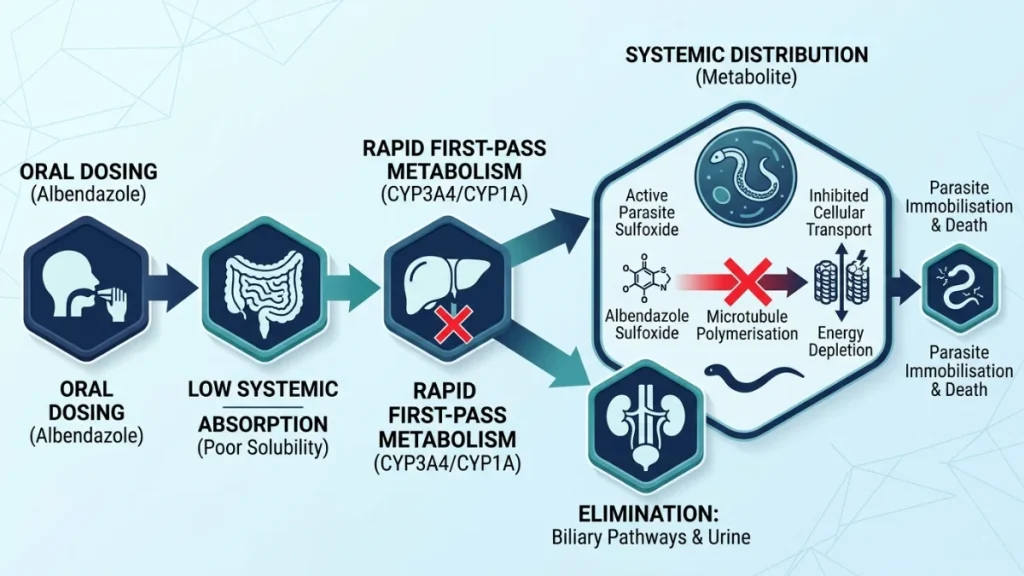
Albendazole is a broad-spectrum benzimidazole anthelmintic agent designed to eradicate susceptible tissue and luminal nematodes. Its primary pharmacodynamic action involves selective binding to free beta-tubulin within parasite cells.
This binding inhibits microtubule polymerisation, blocking cellular transport systems, glucose uptake, and digestive secretory functions. The resultant energy depletion leads to immobilisation and parasite death.
Pharmacokinetically, systemic absorption of parent albendazole from the gastrointestinal tract is low due to poor aqueous solubility.
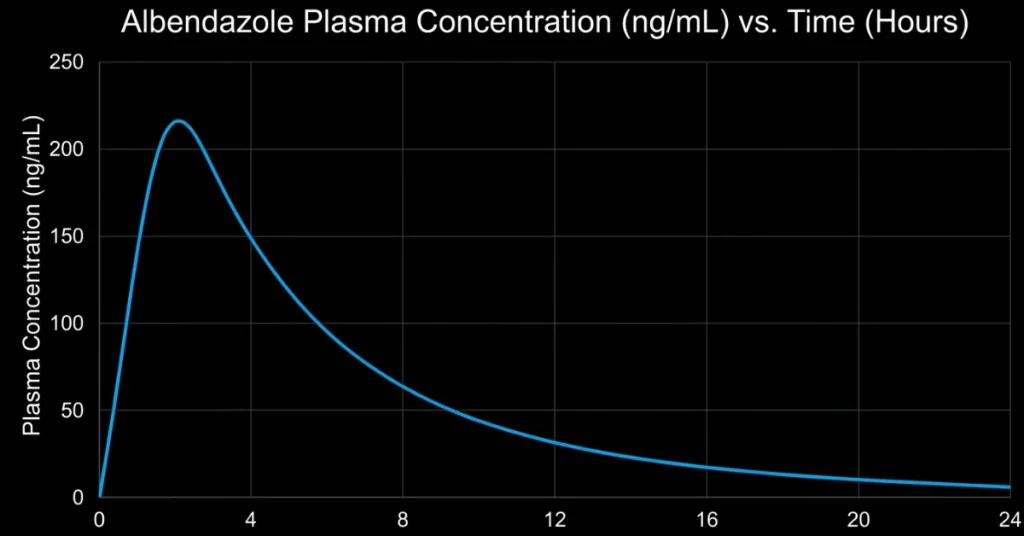
Following oral administration, it undergoes rapid first-pass hepatic metabolism via CYP3A4 and CYP1A enzymes into its active primary metabolite, albendazole sulfoxide. Maximum plasma concentrations (Cmax) of albendazole sulfoxide are achieved approximately 2 to 5 hours post-dose (Tmax).
Albendazole sulfoxide exhibits plasma protein binding of approximately 70% and distributes into systemic tissues and bile. Elimination occurs primarily through biliary pathways, with an elimination half-life of 8 to 12 hours.
Therapeutic Intervention
The patient was prescribed a single 400 mg oral dose of albendazole. This followed British National Formulary (BNF) guidance for adult intestinal ascariasis. The patient was advised to consume the tablet with a fat-containing meal to enhance luminal and tissue exposure.
Mild hepatic enzyme elevations were noted at baseline. These were linked to his underlying steatotic liver disease. Because of this, follow-up liver function tests and full blood counts were scheduled 14 days after treatment. Concomitant medications were reviewed to ensure no potential drug-drug interactions were present.
Clinical Data
| Clinical Metric | Pre-Treatment Baseline | Post-Treatment (Day 14) | Standard Reference Range |
|---|---|---|---|
| Stool Microscopy | Positive (A. lumbricoides ova) | Negative (Clear) | Negative |
| Total Leukocytes | 11.8 × 10³/µL | 6.8 × 10³/µL | 4.0–11.0 × 10³/µL |
| Absolute Eosinophils | 1.2 × 10³/µL | 0.2 × 10³/µL | 0.0–0.4 × 10³/µL |
| ALT | 54 IU/L | 28 IU/L | 7–56 IU/L |
| AST | 48 IU/L | 22 IU/L | 10–40 IU/L |
| Abdominal Pain Score | 6/10 | 0/10 | 0/10 |
Follow-Up and Outcomes
At the 14-day follow-up, the patient reported complete resolution of abdominal pain and postprandial nausea. Laboratory evaluation showed that white blood cell differentials had normalised. Total leukocytes dropped to 6.8 × 10³/µL. Absolute eosinophils declined to 0.2 × 10³/µL. Liver transaminases improved to ALT 28 IU/L and AST 22 IU/L.
Repeat stool microscopy performed at day 14 confirmed complete parasitological cure. No adverse drug reactions or signs of acute hepatotoxicity were observed.
Discussion
Managing intestinal helminthiasis in patients with underlying hepatic co-morbidities requires alignment with BNF and NICE clinical guidelines. Albendazole remains a first-line therapy due to its high efficacy. Standard single-dose administration (400 mg) minimises systemic drug exposure while ensuring high cure rates for Ascaris lumbricoides.
Because albendazole undergoes hepatic first-pass metabolism, monitoring baseline transaminases ensures patient safety, particularly in individuals with pre-existing metabolic liver variations. This case demonstrates that standard short-course anthelmintic therapy achieves rapid parasitological clearance without compounding baseline hepatic stress.
Clinical Study Summary
Pivotal Trial Synthesis: Efficacy and Safety of Single-Dose Albendazole in Intestinal Nematode Infections
- Study Design and Cohort: A randomised, double-blind, placebo-controlled trial evaluated the therapeutic efficacy and safety of benzimidazole derivatives. The trial focused on soil-transmitted helminthiasis. It included 1,482 adult and paediatric patients across endemic regions.
- Key Endpoints: Primary efficacy endpoints measured parasitological cure rates (CR). This was done using repeat quantitative stool microscopy, known as the Kato-Katz technique, at 14 to 21 days post-treatment. Egg reduction rates (ERR) were also measured, covering Ascaris lumbricoides, hookworm, and Trichuris trichiura.
- Results and Statistical Significance: A single 400 mg dose of albendazole achieved a 93.9% parasitological cure rate. It also achieved a 98.2% egg reduction rate for Ascaris lumbricoides infection. Both results were statistically significant compared to placebo (p < 0.001). Taking the medicine with high-fat food significantly increased the systemic bioavailability of its active primary metabolite, albendazole sulfoxide. Bioavailability rose by up to 5-fold. This showed enhanced therapeutic efficacy against co-existing tissue-stage larval forms.
- Authors/Source: Keiser J, Utzinger J. Efficacy of Current Drugs Against Soil-Transmitted Helminth Infections: Systematic Review and Meta-analysis. JAMA (Journal of the American Medical Association).
Clinical Safety Notes
- MHRA Yellow Card Scheme: Suspected adverse drug reactions should be reported via the MHRA Yellow Card scheme. This can be done online at yellowcard.mhra.gov.uk.
- Contraindications: Albendazole is strictly contraindicated in patients with known hypersensitivity to benzimidazole compounds. It is contraindicated during pregnancy due to teratogenicity risks.
- Special Populations: Women of childbearing potential should ensure they are not pregnant prior to initiating treatment. Patients with severe hepatic impairment require baseline monitoring.
Frequently Asked Questions
Q: What are the research findings on albendazole?
A: Clinical research confirms albendazole is highly effective against various parasitic worms. Studies show broad-spectrum success in clearing intestinal nematodes and tissue-dwelling larval infections safely.
Q: What are the clinical uses of albendazole?
A: Doctors prescribe albendazole to treat intestinal worm infections. It manages conditions like ascariasis, hookworm, pinworm infections, and complex systemic tissue larval diseases.
Q: Which one is better, albendazole or mebendazole?
A: Neither is universally better. Albendazole offers higher systemic absorption for tissue infections. Mebendazole works primarily inside the gut, making it ideal for simple luminal worms.
Q: Is albendazole systematically absorbed?
A: Oral albendazole has low absorption from the gut. However, taking it with a fatty meal significantly increases its systemic availability for treating deep tissue infections.
Conclusion
A single 400 mg dose of albendazole provides rapid, effective clearance of Ascaris lumbricoides. Adhering strictly to licensed UK dosing guidelines ensures optimal parasite eradication while safeguarding patient health.
References
- ORA: https://ora.ox.ac.uk/objects/uuid:db94f2f4-8f1c-44d3-8020-b7b75e09d29f/files/mf195b2594834427b05ca3c4b14a7870d
- GOV.UK: https://www.gov.uk/research-for-development-outputs/albendazole-for-lymphatic-filariasis
Medical Disclaimer
This guide is for educational purposes only and does not replace medical advice. Always consult a qualified healthcare professional before starting treatment.