

Foracort 100: Budesonide 100mcg for Better Breathing
Foracort 100 is a prescription combination inhaler containing Budesonide 100mcg and Formoterol 6mcg. This inhaler is used to both treat and prevent asthma and chronic obstructive pulmonary disease (COPD) symptoms in adult patients, addressing the condition from two clinical angles simultaneously. The reference UK brand Symbicort may be better known to some patients. This is completely normal as they contain the same active ingredient. Because of the clinical complexity of respiratory conditions, medical supervision throughout the entire course of this treatment is essential.
During a consultation, your doctor or pharmacist may refer to any one of several brand names associated with combination inhalers available in the UK. Foracort 100 is one option your doctor or respiratory specialist may discuss with you.
Asthma and COPD affect millions of people. Many patients struggle with daily breathlessness, wheezing, and reduced quality of life. Effective long-term inhaler therapy can significantly improve these symptoms.
Foracort 100 contains two active ingredients: Budesonide 100mcg and Formoterol 6mcg. It belongs to the combined inhaled corticosteroid and long-acting beta2-agonist (ICS/LABA) class.
This guide is written to help UK patients understand how Foracort 100 works, what it treats, and how to use it correctly and safely.
What Is Foracort 100?
Foracort 100 is a prescription-only combination inhaler. Two active medicines are combined within this inhaler, working in combination to control and prevent respiratory symptoms.
Inflammation in the airways is reduced by Budesonide, an inhaled corticosteroid that forms one of the two active components in this medicine. The second active component, Formoterol, acts as a bronchodilator by functioning as a long-acting beta2-agonist (LABA). It brings about relaxation of the muscles surrounding the airways.
Product Information
| PARAMETER | DETAILS |
|---|---|
| Drug Class | Inhaled corticosteroid + Long-acting beta2-agonist (ICS/LABA) |
| Active Ingredients | Budesonide 100mcg + Formoterol 6mcg |
| Prescription Status | Prescription-only medicine (POM) |
| Therapeutic Use | Asthma and COPD management |
| UK Reference Brand | Symbicort |
| Form | Pressurised metered-dose inhaler |
Foracort 100 is a preventer and controller inhaler, not a reliever, and must therefore be used regularly as prescribed rather than only during acute attacks.
How Budesonide and Formoterol Work in the Body
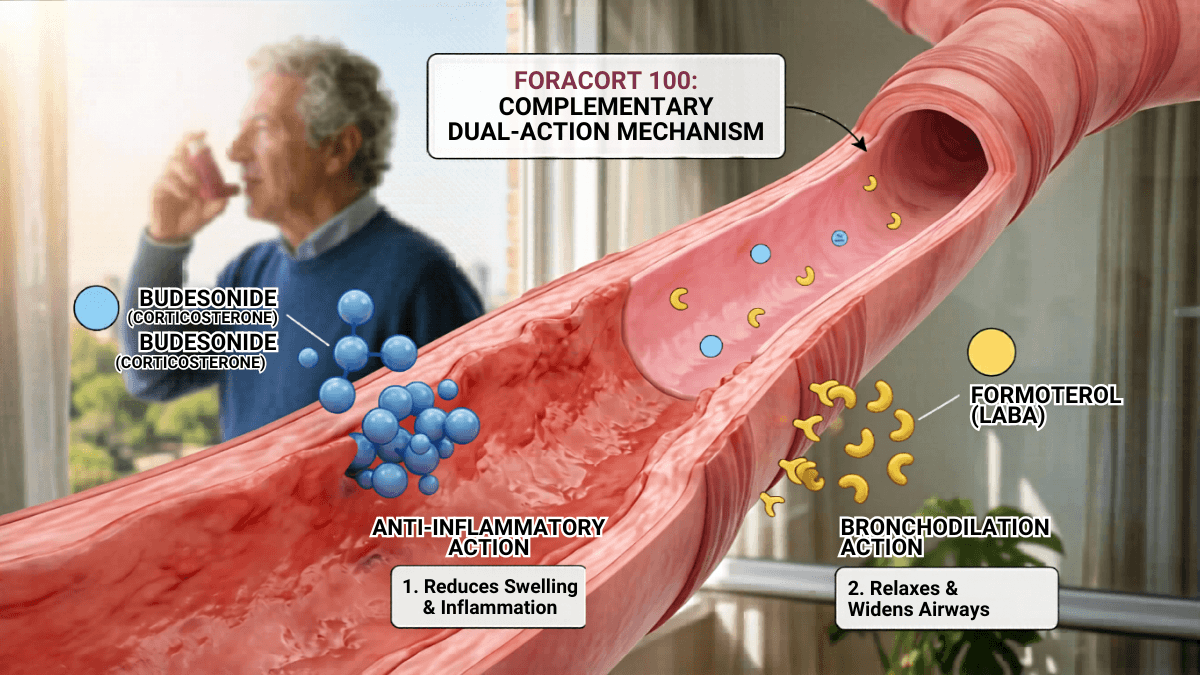
Foracort 100 works through two distinct but complementary mechanisms. Together, they address both the underlying inflammation and the immediate narrowing of the airways.
How Budesonide works
As an inhaled corticosteroid (ICS), Budesonide reduces airway inflammation through a targeted local mechanism. It reduces inflammation (swelling and irritation) inside the airways. Because airway inflammation is reduced, sensitivity to common triggers — including allergens, smoke, and exercise — is significantly diminished. When this inhaler is used consistently over time, both the frequency and severity of asthma attacks and COPD flare-ups are progressively and meaningfully reduced.
How Formoterol works
Acting as a long-acting beta2-agonist (LABA), Formoterol provides sustained bronchodilation by targeting the muscles surrounding the airways. Muscular relaxation and widening of the airways are brought about by Formoterol through its binding action on beta2-adrenergic receptors located on airway smooth muscle. Relaxation of the airway muscles is produced by this action, allowing the airways to widen and reducing the resistance to airflow. Because airway resistance is reduced, breathing is made noticeably easier for the patient.
Together, these dual actions control both the inflammatory cause and the physical narrowing of the airways. This combination is more effective than either medicine used alone for chronic respiratory conditions.
When Doctors Prescribe Foracort 100
Foracort 100 is prescribed for adult patients with chronic respiratory conditions. A doctor will assess your lung function and symptoms before prescribing this inhaler.
Conditions it is used for:
Asthma
Long-term management and prevention of asthma symptoms are the primary clinical purposes for which Foracort 100 is prescribed. Among the symptoms addressed by this medicine are wheezing, breathlessness, chest tightness, and a persistent cough. Because consistent adherence to the prescribed regimen is essential, the frequency of asthma attacks is reduced when the inhaler is used as directed.
Chronic Obstructive Pulmonary Disease (COPD)
Progressive breathing difficulties over time characterise COPD, a long-term lung condition that benefits from consistent inhaled therapy. Foracort 100 helps reduce the number and severity of COPD exacerbations (sudden worsening episodes). Day-to-day lung function in patients with moderate to severe COPD is supported through the regular use of this medicine.
Exercise-Induced Bronchoconstriction
Some patients experience airway narrowing during or after physical activity. Foracort 100 may be prescribed to help prevent exercise-triggered breathing difficulties. The correct timing of doses in relation to exercise will be advised by your doctor based on your individual clinical needs.
Benefits of Foracort 100
Dual-action symptom control
Foracort 100 addresses two key problems in respiratory conditions simultaneously. Budesonide reduces airway inflammation whilst Formoterol relaxes airway muscles. Both immediate symptom relief and sustained long-term control of respiratory disease are delivered through this combined therapeutic approach.
Reduced frequency of attacks
The number of asthma attacks and COPD flare-ups experienced by a patient is significantly reduced through the regular use of Foracort 100. This leads to fewer emergency GP visits and hospital admissions. Consistent use is key to achieving this benefit.
Improved quality of life
Patients using Foracort 100 regularly often report better sleep, improved exercise tolerance, and fewer daily symptoms. Gaining better control of a respiratory condition restores confidence in daily activities. Many patients experience fewer disruptions to work and family life.
Localised delivery with reduced systemic effects
Because inhaled medicines are delivered directly to the lungs, systemic exposure is minimised compared with oral treatments, reducing the risk of whole-body side effects. This reduces the amount of medicine absorbed into the rest of the body. As a result, the risk of systemic (whole-body) side effects is lower than with oral steroid medicines.
Alternative Medicine Doctors May Consider
A GP or respiratory specialist may recommend an alternative combination inhaler where the severity of the condition or the patient’s clinical profile makes it more appropriate.
- Symbicort (Budesonide/Formoterol) — the UK reference brand containing identical active ingredients to Foracort 100
- Seretide (Fluticasone/Salmeterol) — an alternative ICS/LABA combination inhaler widely prescribed across the UK for both asthma and COPD
- Fostair (Beclometasone/Formoterol) — a smaller-particle ICS/LABA inhaler that may suit some patients better
- Relvar Ellipta (Fluticasone/Vilanterol) — a once-daily ICS/LABA inhaler option for eligible patients
- Single-agent inhalers — in mild asthma, a preventer inhaler (ICS alone) may be sufficient without a LABA component
Your doctor will select the most appropriate inhaler based on your condition, inhaler technique, and personal preference.
Available respiratory inhaler treatment options can be explored by discussing your symptoms with your GP or a registered UK pharmacist.
Possible Side Effects
Like any medicine, Foracort 100 has the potential to produce side effects in some individuals. Not everyone experiences them. Many can be minimised with correct inhaler technique.
| COMMON SIDE EFFECTS | RARE BUT SERIOUS SIDE EFFECTS |
|---|---|
| Hoarse voice or voice changes | Anaphylaxis — a severe allergic reaction presenting as rash, swelling of the face or throat, and difficulty breathing — requires immediate emergency medical attention |
| Oral thrush — a fungal infection of the mouth and throat, among the more commonly reported side effects with inhaled corticosteroids | Paradoxical bronchospasm — a sudden worsening of breathing immediately following inhalation — must be reported to a doctor without delay |
| Headache | Significant palpitations or irregular heartbeat |
| Throat irritation or cough after inhalation | Adrenal suppression — with prolonged high-dose use |
| Mild nausea | |
| Palpitations — more commonly associated with Formoterol |
Reducing the Risk of Oral Thrush
Because rinsing the mouth with water after every dose removes residual medicine from the oral cavity, this step is one of the most important preventive measures against oral thrush. Do not swallow the water — spit it out after rinsing.
Any serious side effect must prompt immediate discontinuation of the inhaler, with urgent medical attention sought without delay. Where breathing difficulties are severe or life-threatening, 999 must be called immediately.
Through the MHRA Yellow Card Scheme at yellowcard.mhra.gov.uk, any suspected side effect can be reported directly by patients or their carers.
Important Safety Advice
Drug interactions
Certain medicines are known to interact with Foracort 100, meaning a full review of all current treatments must be carried out before this inhaler is started. Beta-blockers (used for heart conditions or high blood pressure) may reduce the effectiveness of Formoterol. Some antifungal medicines (such as ketoconazole) and certain HIV medicines can increase the level of Budesonide in the body.
All medicines currently being taken must always be disclosed to both your doctor and pharmacist at every consultation. Herbal supplements and over-the-counter products must be disclosed alongside prescription medicines, as interactions can arise from any of these sources.
Medical conditions to disclose
Tell your doctor before using Foracort 100 if you have any of the following:
- Heart disease or irregular heartbeat
- High blood pressure is among the conditions that must be declared to your doctor before starting this medicine
- Diabetes must be disclosed to your doctor, as it may influence treatment decisions relating to inhaled corticosteroid therapy
- Any thyroid condition must be reported before treatment begins, as it may affect how the medicine is tolerated
- Osteoporosis, a condition characterised by weakened bones, must be declared, as long-term use of inhaled corticosteroids may affect bone density
- A history of tuberculosis (TB)
- Glaucoma or cataracts
Pregnancy and breastfeeding
Before using Foracort 100 during pregnancy or when planning a pregnancy, a discussion with your doctor is essential. Uncontrolled asthma during pregnancy carries its own risks. The benefits and risks of continued treatment during pregnancy will be carefully assessed by your doctor before any decision is made. Where breastfeeding is ongoing, medical advice must be sought before use of this medicine is continued.
Alcohol
There is no direct clinical interaction between Foracort 100 and alcohol. However, alcohol can worsen respiratory symptoms in some patients. Alcohol consumption during treatment should be kept to a minimum, and any concerns about its interaction with this medicine must be discussed with your doctor.
Stopping Your Inhaler
Foracort 100 does not cause physical dependence. However, stopping it suddenly without medical advice can cause asthma or COPD symptoms to worsen rapidly. Never stop using this inhaler without first speaking to your doctor or pharmacist.
Long-term use and steroid effects
At higher doses, long-term use of inhaled corticosteroids can produce systemic effects in certain patients, which is why the lowest effective dose is always prescribed. Reduced bone density, changes in eye pressure, and adrenal suppression are among the systemic effects that may arise with prolonged higher-dose use. Because minimising systemic exposure is a clinical priority, the lowest effective dose will always be prescribed by your doctor. Because inhaled corticosteroid therapy requires ongoing clinical oversight, regular monitoring appointments must be attended throughout the course of treatment.
When Should You Speak to a Doctor?
Where any of the following symptoms or concerns arise during treatment, your GP or respiratory specialist must be informed without delay.
- Your breathing symptoms are not improving despite regular inhaler use
- You need your reliever inhaler (such as salbutamol) more frequently than usual
- Contact your GP if you notice white patches in your mouth or throat, which may indicate oral thrush
- Your voice becomes persistently hoarse
- You experience palpitations, chest pain, or irregular heartbeat
- Any swelling, skin rash, or difficulty breathing that develops after inhalation must be treated as a potential sign of a serious reaction and reported immediately
Call 999 immediately or go to your nearest A&E if you experience a sudden, severe worsening of breathing. This may indicate a serious asthma attack or bronchospasm requiring urgent treatment.
Can Foracort 100 Be Used With Other Medicines?
Foracort 100 can interact with a number of medicines. The most important interactions involve beta-blockers and medicines that affect liver enzymes.
A complete and up-to-date list of all medicines currently being taken must always be provided to your GP and pharmacist at every consultation. This includes inhalers, tablets, liquids, and supplements. Never adjust your Foracort 100 dose or stop using it without first seeking advice from your doctor or pharmacist.
How to Use Foracort 100 Correctly
Correct inhaler technique is essential for Foracort 100 to work effectively. Because poor inhaler technique reduces the amount of medicine reaching the lungs, correct use is essential to achieving effective treatment.
Step-by-step inhaler technique:
- Shake the inhaler well before each use
- Exhale completely — breathe out fully before placing the mouthpiece in your mouth
- Seal your lips around the mouthpiece
- Press and inhale — press the canister down whilst breathing in slowly and deeply through your mouth
- Hold your breath for 5 to 10 seconds to allow the medicine to reach deep into the lungs
- Rinse your mouth with water after every dose and spit — do not swallow
The number of puffs and frequency of use prescribed by your doctor must be followed carefully at all times. Exceeding the prescribed dose carries clinical risks and must not be done under any circumstances.
Storage and Handling Advice
Foracort 100 must be stored at room temperature and must not be kept in conditions where the temperature exceeds 25°C. Direct sunlight, heat, and frost must all be avoided when storing the inhaler to maintain its integrity and effectiveness. Even when empty, the canister must not be punctured or exposed to flame or heat under any circumstances.
All medicines, including this inhaler, must be stored where children are completely unable to reach or see them. Because environmental factors can degrade the inhaler, it must always be returned to its original packaging when not in use. The dose counter must be checked regularly to ensure the inhaler is replaced before it runs out.
Do not use the inhaler after its expiry date. Safe disposal of an empty inhaler must be discussed with your pharmacist, who can advise on appropriate take-back schemes available through local pharmacies. Many pharmacies offer inhaler take-back schemes as part of NHS sustainability initiatives. Never dispose of inhalers in general household waste.
Responsible Access to Treatment in the UK
As a prescription-only medicine (POM) in the UK, Foracort 100 can only be legally obtained through a valid prescription from a registered UK doctor.
Purchasing inhalers from unregulated online sources carries significant risks to patient safety and must be avoided entirely. Counterfeit inhalers may not contain the correct dose and can be dangerous.
Before starting, stopping, or modifying this treatment in any way, a registered UK doctor or pharmacist must always be consulted.
FAQs
Q: What is Foracort 100 used for?
A: Foracort 100 contains Budesonide 100mcg and Formoterol 6mcg, and is used to treat and prevent asthma and COPD symptoms in adults. Because this is a prescription-only medicine with a complex mechanism of action, its use is permitted only under the active supervision of a registered UK doctor or respiratory specialist.
Q: Is Foracort a strong steroid?
A: Foracort contains Budesonide, a moderate-strength inhaled corticosteroid. Because it works locally in the airways rather than systemically, it reduces inflammation safely when used as prescribed.
Q: What are the common mistakes when using an inhaler?
A: Common mistakes include not shaking the inhaler, exhaling incorrectly, inhaling too quickly, and not rinsing the mouth afterwards. Because correct inhaler technique is essential to effective treatment, your doctor’s guidance on technique must be followed carefully at all times.
Q: Is it safe to take Foracort daily?
A: As a preventer inhaler, Foracort 100 is formulated for regular daily use rather than for acute symptom relief. Never stop suddenly without first seeking advice from your doctor or pharmacist. Regular use controls symptoms and reduces asthma and COPD flare-ups effectively.
Conclusion
Foracort 100 is a combination prescription inhaler containing Budesonide 100mcg and Formoterol 6mcg. Long-term management and prevention of both asthma and COPD symptoms in adult patients are the clinical indications for which this medicine is used.
It works through a dual mechanism. Budesonide reduces airway inflammation, whilst Formoterol relaxes airway muscles. Daily symptom control and a meaningful reduction in the risk of acute attacks are both delivered by the combined action of the two active ingredients. The reference UK brand Symbicort may be better known to some patients. This is completely normal as they contain the same active ingredient.
Correct inhaler technique, regular medical review, and consistent daily use are all essential for Foracort 100 to work effectively. Never stop using this inhaler suddenly without first speaking to your doctor.
If you have any concerns about your respiratory condition or inhaler treatment, speak to your GP or a registered UK pharmacist.
References
- NHS. Asthma: Treatment. Available at: www.nhs.uk
- MHRA. Budesonide/Formoterol: Summary of Product Characteristics. Available at: www.gov.uk/mhra
- NICE. Asthma: Diagnosis, Monitoring and Chronic Asthma Management (NG80). Available at: www.nice.org.uk
- Global Initiative for Asthma (GINA). Global Strategy for Asthma Management and Prevention, 2024.
Important Information
This article is for informational purposes only and does not replace professional medical advice. Always consult a registered healthcare professional before starting or changing any treatment.