
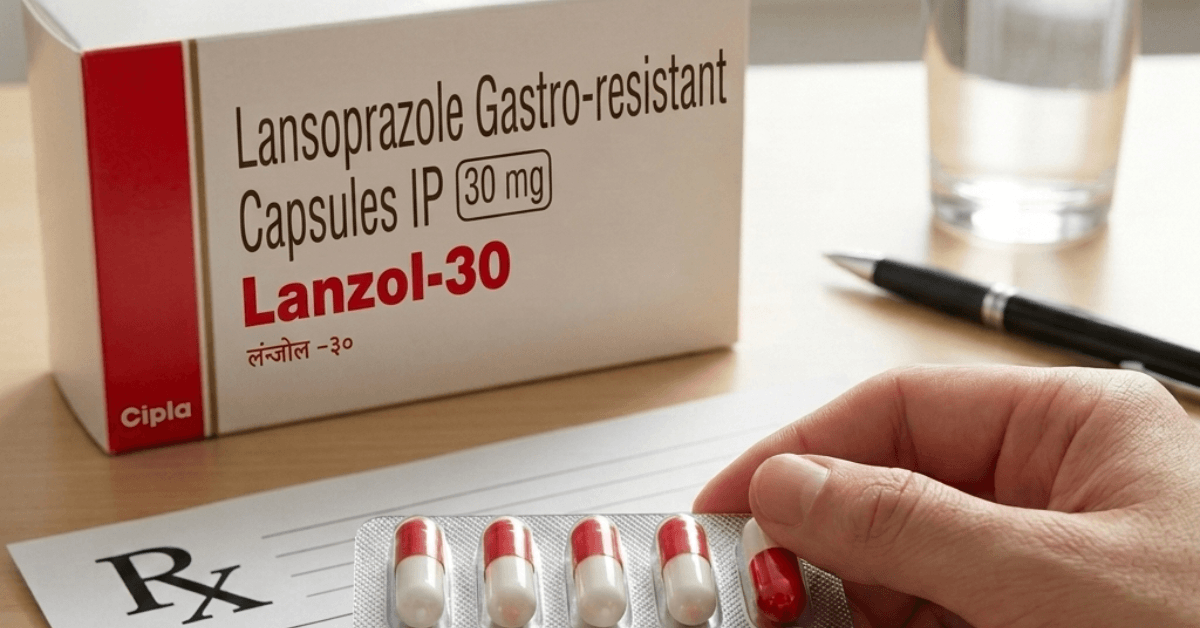
Lanzol 30: Lansoprazole 30mg for Acid Relief
Lanzol 30 is a prescription capsule containing Lansoprazole 30mg. Belonging to a well-established class of medicines, Lansoprazole is recognised as a proton pump inhibitor (PPI). Acid reflux, GORD, stomach ulcers, and other digestive conditions are among the indications for which it is prescribed. By targeting the acid-producing mechanism in the stomach, the amount of acid generated is significantly reduced.
How Lansoprazole Works in the Body
Embedded within the stomach lining are specialised cells that house microscopic structures called proton pumps. Hydrochloric acid is released into the stomach by these pumps. Although acid plays an essential role in digestion, excess production leads to damage in both the stomach lining and the food pipe.
Lansoprazole works by directly blocking the proton pump enzyme at its source. This significantly and permanently reduces acid production. Unlike antacids, which neutralise acid after it forms, Lansoprazole prevents it from being produced in the first place.
With less acid present, inflamed or damaged tissue can heal. As acid levels are brought down, symptoms like heartburn and regurgitation are gradually relieved. Most patients notice relief within two to three days of starting treatment.
To achieve the most effective result, taking Lanzol 30 at least 30 minutes prior to a meal is strongly advised. The capsule must be swallowed whole, accompanied by a glass of water. Crushing or chewing the capsule alters its release mechanism, which in turn disrupts how it is absorbed.
UK Brand Reference
A number of different brand names are used across the UK to market Lansoprazole 30mg. The table below compares Lanzol 30 with the UK reference brand, Zonton FasTab.
| Feature | Lanzol 30 | Zonton FasTab |
|---|---|---|
| Active Ingredient | Lansoprazole | Lansoprazole |
| Strength | 30 mg | 30 mg |
| Formulation | Hard capsule (delayed-release) | Orodispersible tablet (dissolves on tongue) |
| Drug Class | Proton Pump Inhibitor (PPI) | Proton Pump Inhibitor (PPI) |
| Prescription Status | POM (Prescription Only Medicine) | POM (Prescription Only Medicine) |
| Therapeutic Use | Acid reduction, ulcer healing, GORD | Acid reduction, ulcer healing, GORD |
| Key Differentiator | Standard oral capsule — must be swallowed whole | No water needed — ideal for dysphagic patients or on-the-go use |
Both medicines contain the same active ingredient and work in the same way. Your doctor or pharmacist will advise which formulation is most appropriate for you.
Clinical Uses

UK doctors prescribe Lanzol 30 for the following conditions:
- Gastro-oesophageal reflux disease (GORD) — because acid flows back into the food pipe in GORD, heartburn and regurgitation are commonly experienced as a result
- Oesophagitis — inflammation and damage to the oesophagus caused by chronic acid reflux
- Stomach and duodenal ulcers — open sores in the stomach lining or upper intestine, known as stomach and duodenal ulcers, require acid suppression to support healing
- NSAID-induced ulcers — ulcers caused or worsened by painkillers such as ibuprofen; Lanzol 30 may be prescribed alongside NSAIDs for protection
- H. pylori eradication — used in combination with antibiotics (triple therapy) to eliminate the Helicobacter pylori bacterium responsible for peptic ulcers
- Zollinger-Ellison syndrome — a rare condition called Zollinger-Ellison syndrome leads to excessive stomach acid. Higher doses are used to manage it, always under specialist supervision
- Acidity and indigestion — symptomatic relief where excess acid is the underlying cause
Safety Information
| Category | Side Effect | Notes |
|---|---|---|
| Common Side Effects | Nausea or vomiting | Mild; resolves as body adjusts |
| Headache | Mild; resolves as body adjusts | |
| Dizziness | Mild; resolves as body adjusts | |
| Diarrhoea or constipation | Mild; resolves as body adjusts | |
| Wind (flatulence) | Mild; resolves as body adjusts | |
| Dry sensation in the mouth | Mild; resolves as body adjusts | |
| General tiredness or fatigue | Mild; resolves as body adjusts | |
| Itching or skin rash | Mild; resolves as body adjusts | |
| Serious Side Effects | Severe allergic reaction | Swelling of face, lips, or throat; breathing difficulties or anaphylaxis — seek urgent care |
| Persistent or worsening diarrhoea | May indicate C. diff infection — seek urgent care | |
| Muscle cramps, irregular heartbeat, or seizures | May indicate low magnesium (hypomagnesaemia) — seek urgent care | |
| Vomiting blood or black, tarry stools | Signs of digestive tract bleeding — seek urgent care | |
| Unexplained weight loss, swallowing difficulty, or persistent vomiting | — seek urgent care |
MHRA Yellow Card Scheme
Any side effect experienced whilst taking Lanzol 30 may be reported directly to the MHRA Yellow Card scheme at yellowcard.mhra.gov.uk. By reporting side effects, patients contribute to improving medicine safety across the UK.
Safety Advice
Drug interactions
Lanzol 30 interacts with several medicines. Do not take it alongside atazanavir or rilpivirine (used to treat HIV), methotrexate (used in cancer or rheumatoid arthritis), or warfarin (a blood-thinning medicine). Because interactions can affect safety and treatment outcomes, all medicines — including herbal supplements and over-the-counter products — should be shared openly with your doctor and pharmacist.
Alcohol
Avoid alcohol whilst taking Lanzol 30. Alcohol increases drowsiness and can stimulate excess stomach acid production. Treatment effectiveness is reduced and the likelihood of side effects is increased when these interactions occur.
Liver conditions and Chromogranin A testing (Test for neuroendocrine tumours )
Tell your doctor if you have or have had any of the following. If a Chromogranin A (CgA) blood test is scheduled, your doctor should be informed in advance. Lanzol 30 can raise CgA levels and affect test results. Temporarily stopping the medicine prior to testing may be advised by your doctor.
Long-term use risks
Prolonged use of Lanzol 30 may lead to low magnesium levels, low vitamin B12, and an increased risk of bone fractures, particularly of the hip, wrist, or spine. It is also associated with a higher risk of C. difficile diarrhoea. During long-term treatment, regular blood tests may be arranged by your doctor to monitor for these effects.
Driving and operating machinery
Lanzol 30 can cause dizziness. Only when full alertness is confirmed should driving or operating heavy machinery be attempted. Contact your GP if you notice any dizziness or unsteadiness after taking this medicine, and stop driving at once.
Pregnancy and breastfeeding
Because complete safety evidence during pregnancy remains unavailable, Lansoprazole use in this period requires careful consideration. Prompt consultation with your doctor is essential if pregnancy is planned, confirmed, or breastfeeding is ongoing. A careful assessment of the benefits and risks will be carried out by your doctor before any treatment guidance is given.
Accessing Treatment Responsibly
Patient safety and appropriate clinical oversight are safeguarded by this legal requirement.
If you are accessing Lanzol 30 through an online pharmacy, confirm that the pharmacy is registered with the MHRA and displays the EU common logo for verified online pharmacies. Purchasing medicines from unregulated or unverified sources carries serious health risks.
Before starting, stopping, or adjusting any treatment, a qualified UK healthcare professional should always be consulted. See available treatment options for acid reflux and digestive health.
Frequently Asked Questions
Q: What is Lanzol 30 used for?
A: Lanzol 30 treats acid reflux, GORD, and stomach ulcers. It contains Lansoprazole 30mg. Doctors prescribe it to reduce excess stomach acid and support digestive healing.
Q: What are the benefits of using Lanzol?
A: Heartburn is relieved, stomach ulcers are healed, and acid reflux symptoms are reduced by Lanzol 30. It protects the stomach lining and significantly improves daily digestive comfort.
Q: Can Lanzol 30 be taken twice a day?
A: Most patients take Lanzol 30 once daily. For certain conditions, twice-daily prescribing may be recommended by your doctor. Your doctor’s instructions should always be followed with care.
Conclusion
Lanzol 30 (Lansoprazole 30mg) is a clinically well-established proton pump inhibitor widely used across the UK. It effectively reduces stomach acid and supports the treatment and healing of a range of digestive conditions, including GORD, peptic ulcers, and H. pylori infection.
Responsible use under medical supervision is essential. Long-term treatment carries specific risks that require monitoring by your doctor. Always take Lanzol 30 exactly as prescribed, report any unusual symptoms promptly, and never adjust your dose without medical advice.
For personalised guidance, speak with your GP, hospital specialist, or registered pharmacist.
References
- NHS. Lansoprazole. Available at: www.nhs.uk
- MHRA. Proton Pump Inhibitors: Known Risks. GOV.UK
- NICE. Gastro-oesophageal reflux disease and dyspepsia in adults. Clinical Guideline CG184
Medical Disclaimer
The article serves as information only, not professional medical advice. The aim is to aid the patient-health professional relationship, not replace it. Consult a qualified UK healthcare professional before adjusting any medication. For emergencies, call 999 or visit A&E promptly.