
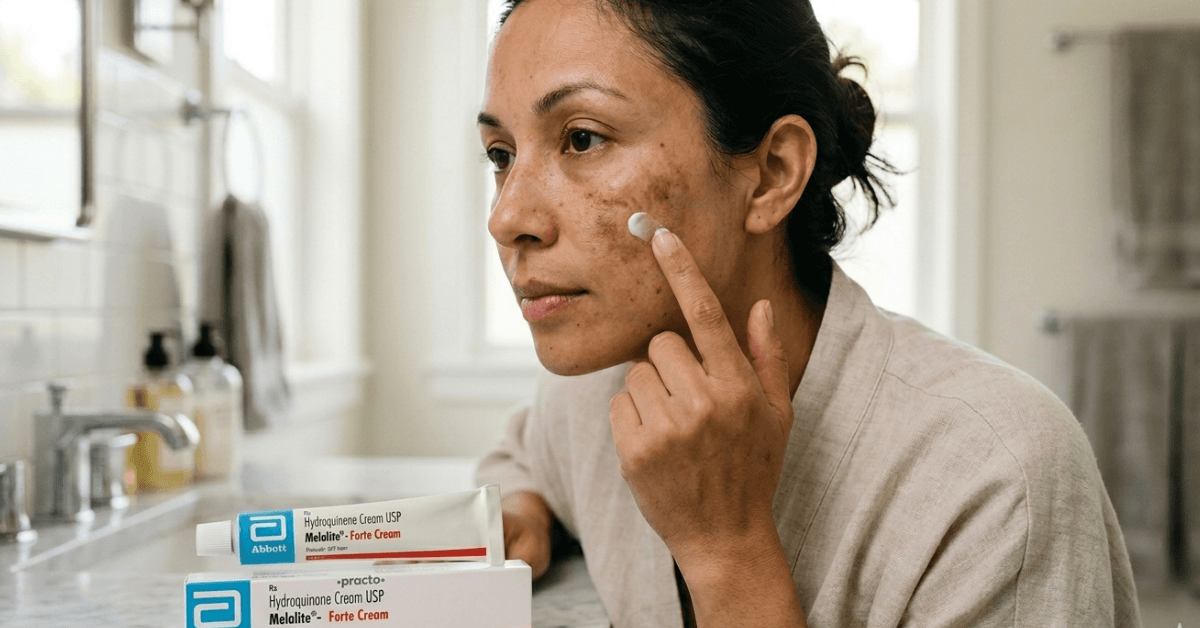
Hydroquinone 4% is the active ingredient found in Melalite Forte, a prescription skin-lightening cream. It is available only on prescription. Melalite Forte is prescribed to treat melasma, dark spots, and hyperpigmentation. By acting on the skin at a cellular level, melanin production is inhibited — which gradually lightens affected areas. A registered dermatologist or qualified healthcare professional must issue a prescription before the cream can be obtained.

Dark patches on the skin can affect your confidence and daily life. Many patients in the UK are prescribed hydroquinone-based creams to manage hyperpigmentation.
You may have heard of Melalite Forte or similar brands like Dermatica. These are commonly used treatments for melasma and uneven skin tone.
The medicine is a prescription medicine in the UK. Learn how it works, its benefits, side effects, and safety advice.
What Is Melalite Forte?
Melalite Forte is a topical cream used to lighten areas of darkened skin. Hydroquinone 4% is the active substance within this cream. It is classified as a depigmenting agent and melanin synthesis inhibitor. It belongs to a group of medicines called depigmenting agents and melanin synthesis inhibitors. Doctors prescribe it for skin conditions where melanin is overproduced.
In the UK, hydroquinone creams are prescription-only medicines (POM). You must obtain medicine with a valid prescription from a registered healthcare professional.
Medicine Information Summary
| Detail | Information |
|---|---|
| Medicine name | Melalite Forte |
| Active ingredient | Hydroquinone |
| Strength | 4% w/w |
| Drug class | Depigmenting agent / Melanin synthesis inhibitor |
| Prescription status | Prescription-only medicine (POM) in the UK |
| Primary use | Melasma, hyperpigmentation, dark spots |
| Regulatory body | MHRA (UK) |
How Hydroquinone Works in the Body
Hydroquinone inhibits the enzyme tyrosinase. This enzyme plays a key role in producing melanin, the pigment that gives skin its colour.
When tyrosinase is inhibited, the skin produces less melanin. Dark patches and uneven skin tone are visibly reduced as the cream takes effect over time.
Results are achieved gradually rather than immediately. Visible improvement in skin tone is typically observed by most patients once four to six weeks of regular use have passed.
When Doctors Prescribe Melalite Forte
Doctors and dermatologists prescribe Melalite Forte for several skin conditions. These include melasma, post-inflammatory hyperpigmentation, and age spots.
Common conditions it is prescribed for include:
- Melasma — dark facial patches arising from hormonal changes or prolonged sun exposure.
- Post-inflammatory hyperpigmentation: refers to stubborn dark marks left behind on the skin after acne or a skin injury has healed
- Solar lentigines — because the skin is exposed to sunlight over many years, flat pigmented spots known as solar lentigines can develop on the surface
- Chloasma — skin darkening often associated with pregnancy or hormonal contraceptives
Before a prescription is issued, your skin type will be assessed by your doctor. Hydroquinone is not suitable for everyone and requires professional supervision.
Benefits of Melalite Forte
Melalite Forte offers targeted treatment for stubborn skin pigmentation. Its 4% hydroquinone concentration is considered effective for moderate to severe melasma.
Clinical benefits include:
Reduces melanin overproduction
Hydroquinone directly targets the cause of hyperpigmentation. At the cellular level, melanin synthesis is slowed by the action of hydroquinone.
Gradually evens skin tone
Treated areas grow progressively lighter. With continued application, the skin tone across those areas becomes more uniform. Patients often report improved skin clarity over several weeks.
Supports overall skin confidence
Many patients find that treating hyperpigmentation improves their confidence. Managing visible skin changes can positively impact daily well-being.
Works alongside sun protection
When used with a high-SPF sunscreen, Melalite Forte helps prevent new dark spots from forming. This makes it part of a broader skin management approach.
Results vary between individuals. Progress will be monitored by your dermatologist, who will adjust the treatment plan if required.
Alternative Medicine Doctors May Consider
Depending on skin type and how well the skin responds, alternative depigmenting options may be considered by your GP or dermatologist. These alternatives are used when hydroquinone is unsuitable or intolerable.
Common alternatives include:
- Azelaic acid — a gentler option, often used for sensitive skin
- Kojic acid — a naturally derived depigmenting agent
- Tranexamic acid — increasingly used for melasma, especially in darker skin tones
- Tretinoin — a retinoid that aids skin cell turnover and pigment fading
- Combination creams — Pigmanorm — which contains hydroquinone, tretinoin, and a corticosteroid — may be considered as an alternative
Platforms such as Dermatica and Skin+Me provide custom-compounded hydroquinone formulations prescribed by UK clinicians. Learn more about available depigmenting agent treatments on our pharmacy guide.
Possible Side Effects
Like all medicines, Melalite Forte can cause side effects. Because the skin requires time to adapt to the active ingredient, most reported side effects tend to be mild and settle without any specific intervention. They are generally resolved without intervention as the skin gradually adapts to the cream.
Common side effects:
| Side Effect | Frequency | Description |
|---|---|---|
| Mild redness or skin irritation | Common | Redness or irritation may occur at the site of application, particularly during the initial weeks of use |
| Dryness or skin peeling at the site of application | Common | The treated area may become dry or begin to peel as the skin adjusts to the cream |
| A temporary sensation of stinging or burning on the skin | Common | A mild stinging or burning feeling may be noticed shortly after application and typically settles quickly |
| Increased skin sensitivity to sunlight | Common | The skin may become more sensitive to sunlight during treatment, making sun protection essential |
| Persistent skin inflammation | Less Common | Ongoing redness or swelling that does not settle on its own and requires review by a GP or dermatologist |
| Allergic contact dermatitis | Less Common | A skin reaction caused by sensitivity to an ingredient in the cream, presenting as itching, redness, or a rash |
| Paradoxical darkening of the skin | Less Common (Rare) | In some cases, the skin may darken rather than lighten, which is an uncommon reaction requiring medical review |
| Ochronosis — bluish-black skin discolouration | Rare | A rare condition associated with prolonged high-dose use, causing a bluish-black discolouration of the treated skin |
Before beginning regular application, a patch test should always be carried out. Whether any skin reaction is likely can be determined by applying a small quantity to the inner arm and leaving it for 24 hours before proceeding with regular use.
If you experience severe irritation, swelling, or worsening skin changes, stop using the cream and contact your GP or dermatologist immediately.
Important Safety Advice
Sun exposure
Hydroquinone increases skin sensitivity to UV light. Always apply SPF 30 or above every morning during treatment.
Duration of use
Do not use Melalite Forte for longer than six consecutive months. After completing a course, take a break of at least three months before restarting.
Pregnancy and breastfeeding
During pregnancy, hydroquinone must not be used during pregnancy. If you become pregnant whilst using this medicine, stop immediately and speak to your GP.
Children
Melalite Forte carries no recommendation for use in children aged under 12 years. Safety data for this age group is insufficient.
Drug interactions
Avoid using Melalite Forte alongside benzoyl peroxide, strong chemical exfoliants (AHAs and BHAs), or alcohol-based toners. These can increase irritation and reduce treatment effectiveness.
Skin conditions to disclose
Tell your doctor if you have eczema, psoriasis, or a history of allergic skin reactions. Hydroquinone may worsen certain existing skin conditions.
Avoiding sensitive areas
Application near the eyes, lips, or mucous membranes must be avoided at all times. Keep the cream away from broken or sunburned skin.
When Should You Speak to a Doctor?
Contact your GP if you notice any of the following:
- No visible improvement after eight weeks of consistent use
- A notable worsening of skin darkening rather than improvement
- Swelling or marked redness can indicate an allergic reaction. Such signs must be reported to your GP without delay
- Should blistering or open sores develop at the area where the cream has been applied, your GP must be informed promptly
- Unexpected changes occurring in areas of skin that have not been treated
Do not continue treatment without medical review if side effects persist. If necessary, your GP or dermatologist may adjust your dose or suggest a different treatment option.
Can Melalite Forte Be Used With Other Medicines?
All medicines currently being taken should be disclosed to your GP or pharmacist before starting Melalite Forte. This includes prescription medicines, over-the-counter products, and supplements.
Combining multiple skin-active ingredients can increase irritation. Retinoids and exfoliating acids should be used with caution alongside hydroquinone.
Safe combinations of skin products can be discussed with your pharmacist, who is well placed to offer guidance. See available treatment options and speak to a qualified UK pharmacist for personalised guidance.
Storage and Handling Advice
- Store Melalite Forte below 25°C in a cool, dry place
- Direct sunlight and heat sources should be avoided when storing the cream
- Retaining the cream in its original packaging at all times helps preserve its stability and ensures correct identification
- Children must not be able to see or reach this cream at any time
- Using an expired cream carries a risk of reduced efficacy or skin irritation. The cream must be discarded once that date has elapsed
- Do not freeze the product
If you are unsure about storage, ask your pharmacist for advice.
Responsible Access to Treatment in the UK
Melalite Forte holds prescription-only status in the UK. Because Melalite Forte is a prescription-only cream, a pharmacist is unable to dispense it unless a valid prescription has been presented. It cannot legally be purchased over the counter without a prescription.
You can access this treatment through a registered UK dermatologist, GP, or regulated online prescription clinic.
Before beginning or changing any skin treatment, advice must be sought from a registered healthcare practitioner.
FAQs
Q: What is Melalite Forte cream used for?
A: Melalite Forte 4% is a prescription skin-lightening cream. It treats melasma, dark spots, and hyperpigmentation. Because melanin production is reduced, skin tone becomes visibly brighter and more even over time.
Q: Does melalite lighten skin permanently?
A: Melalite Forte 4% hydroquinone reduces pigmentation gradually. Results are not always permanent. Sun exposure and hormonal changes can cause dark spots to return. Consistent sun protection helps maintain results in the long term.
Q: Does Melalite Forte contain steroids?
A: No, Melalite Forte does not contain steroids. Hydroquinone 4%, the active ingredient, works by inhibiting melanin production — making it a skin-lightening agent rather than a steroid-based cream.
Conclusion
Melalite Forte is a clinically established treatment for melasma and hyperpigmentation. It contains 4% hydroquinone, which reduces melanin production in the skin.
Under proper medical supervision, correct use of the cream can improve uneven skin tone and help restore an even, uniform skin tone. However, it carries risks if used without guidance, particularly with long-term use.
In the UK, this medicine is prescription-only. Because Melalite Forte is a potent prescription cream, guidance from a registered healthcare professional must be sought before treatment is commenced.
References
- NHS — Skin conditions and treatments: www.nhs.uk
- MHRA — Medicines regulation in the UK: www.gov.uk/mhra
- British Association of Dermatologists — Melasma patient information leaflet
Medical Disclaimer
This article is for informational purposes only and does not replace professional medical advice. Always consult a qualified healthcare professional before starting or changing any treatment. Melalite Forte is a prescription-only medicine in the UK. Do not use this medicine without a valid prescription from a registered UK healthcare professional.