

Stiff Muscles? Try Parkitidin 100mg Amantadine
Amantadine hydrochloride, its active ingredient, is taken daily by many to address Parkinson’s disease symptoms and movement disorders caused by medicines. Understanding your medicine helps you use it safely and confidently.
Parkitidin 100 is a prescription-only medicine (POM) containing amantadine hydrochloride 100 mg. It is used to manage Parkinson’s disease symptoms such as tremors and rigidity, drug-induced movement disorders, and selected viral infections, including influenza A and herpes zoster. The UK reference brand is Symmetrel, which contains the same active salt at the same strength.
What Is Parkitidin 100?
Parkitidin 100 contains amantadine hydrochloride 100 mg as its active salt. It belongs to two classes of drugs: adamantane antivirals and dopaminergic antiparkinsonism agents. Both tablet and capsule forms are offered for this medicine.
The following shows Parkitidin 100 alongside Symmetrel, the established UK reference brand. Both products contain identical active salt at the same strength.
| Property | Parkitidin 100 | Symmetrel (UK Reference Brand) |
|---|---|---|
| Active Ingredient | Amantadine hydrochloride | Amantadine hydrochloride |
| Strength | 100 mg | 100 mg |
| Dosage Forms | Tablet / Capsule | Capsule / Syrup |
| Drug Class | Adamantane antiviral; dopaminergic antiparkinsonism agent | Adamantane antiviral; dopaminergic antiparkinsonism agent |
| Prescription Status | Prescription-Only Medicine (POM) | Prescription-Only Medicine (POM) |
Your pharmacist can confirm whether Parkitidin 100 or Symmetrel is dispensed in accordance with your prescription. Both are therapeutically equivalent.
How Amantadine Works in the Body
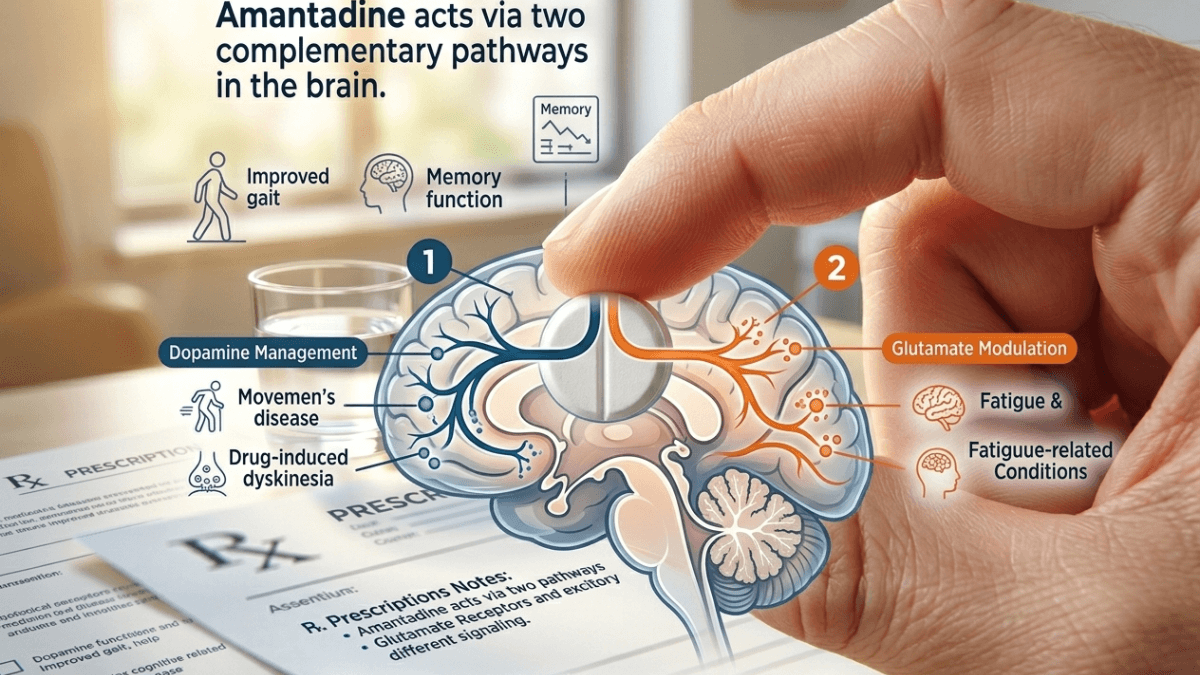
Amantadine acts via two complementary pathways in the brain. Understanding both helps explain why this medicine benefits several different conditions.
First, amantadine stimulates presynaptic dopamine release and slows its neuronal reuptake in the nigrostriatal pathway. This increases dopaminergic transmission between nerve cells. The result is improved voluntary motor control, the core therapeutic benefit in Parkinson’s disease and drug-induced extrapyramidal disorders.
Second, amantadine acts as a low-affinity antagonist at N-methyl-D-aspartate (NMDA) receptors. By reducing glutamate-mediated excitatory neurotransmission, it may ease dyskinesias and calm abnormal motor signals in the brain. Together, these two actions improve rigidity, bradykinesia, and tremor in a clinically meaningful way.
Because the M2 ion channel of influenza A is blocked by amantadine, viral uncoating and replication are effectively prevented. This antiviral use is now less common, with newer agents preferred in current UK practice.
Clinical Uses of Parkitidin 100
Parkitidin 100 is authorised and prescribed in the UK for the following indications:
- Parkinson’s disease — reduces tremor, rigidity, and bradykinesia, particularly in early to moderate disease stages
- Adjunct therapy in Parkinson’s disease — used alongside levodopa or dopamine agonists when additional symptom control is needed
- Drug-induced movement disorders — manage extrapyramidal side effects caused by antipsychotic and other dopamine-blocking medicines
- Influenza A — historically prescribed for prophylaxis and treatment; now largely replaced by neuraminidase inhibitors such as oseltamivir
- Herpes zoster (shingles) — limited antiviral use; aciclovir and valaciclovir are preferred in current UK clinical practice
Your prescriber will determine which indication applies to you and tailor the dose accordingly.
Possible Side Effects
Like any medicine, Parkitidin 100 carries a possibility of side effects. Not all patients will be affected. Milder reactions tend to settle as the body becomes accustomed to treatment.
| Category | Side Effect | Additional Guidance |
|---|---|---|
| Common Side Effects | Nausea and gastrointestinal discomfort | |
| Common Side Effects | Dizziness and postural hypotension | Always rise slowly from sitting or lying positions |
| Common Side Effects | Insomnia and sleep disturbance | |
| Common Side Effects | Dry mouth | |
| Common Side Effects | Constipation | |
| Common Side Effects | Blurred vision | |
| Common Side Effects | Peripheral oedema | Swelling of the ankles or legs |
| Common Side Effects | Livedo reticularis | A mottled, purplish skin discolouration |
| Serious Side Effects | Seizures or convulsions | Contact NHS 111 or attend your nearest A&E without delay |
| Serious Side Effects | Severe confusion, disorientation, or sudden cognitive change | Contact NHS 111 or attend your nearest A&E without delay |
| Serious Side Effects | Hallucinations or psychotic symptoms | Contact NHS 111 or attend your nearest A&E without delay |
| Serious Side Effects | Difficulty breathing or shortness of breath | Contact NHS 111 or attend your nearest A&E without delay |
| Serious Side Effects | Fast, irregular, or pounding heartbeat | Contact NHS 111 or attend your nearest A&E without delay |
| Serious Side Effects | Severe muscle rigidity or uncontrolled involuntary movements | Contact NHS 111 or attend your nearest A&E without delay |
| Serious Side Effects | Signs of a serious allergic reaction | Rash, facial swelling, or difficulty swallowing |
| Serious Side Effects | Significant mood changes, depression, or thoughts of self-harm | Contact NHS 111 or attend your nearest A&E without delay |
Reporting side effects
All patients and healthcare professionals are encouraged to report suspected adverse reactions via the MHRA Yellow Card scheme at yellowcard.mhra.gov.uk. Your report helps protect the safety of other UK patients.
Important Safety Advice
Alcohol
Alcohol must be avoided entirely during treatment with Parkitidin 100. Combining alcohol with amantadine significantly worsens dizziness, confusion, and low blood pressure. Because balance and coordination may be affected by dizziness, the risk of falls and serious accidents is heightened. The combination is contraindicated.
Pregnancy and Breastfeeding
Parkitidin 100 is contraindicated in pregnancy. Animal studies have shown teratogenic potential, and the medicine must not be used by women who are pregnant or planning to conceive. Because of the potential for harm to a nursing infant, breastfeeding is contraindicated while amantadine is being taken, as the medicine is known to pass into breast milk. For women of childbearing age, reliable contraception must be maintained for the entire duration of treatment. This must be discussed with the prescribing doctor before starting the medicine.
Renal and Hepatic Impairment
Being a medicine that is cleared mainly through the kidneys, amantadine requires dose adjustment and careful monitoring in those with mild to moderate renal impairment. In cases of severe renal impairment, Parkitidin 100 must not be used. Caution is advised in patients with hepatic impairment; your prescriber will determine whether a dose adjustment is appropriate for your individual situation.
Cardiac and Neurological Conditions
Use Parkitidin 100 with caution if you have a history of congestive heart failure, cardiac arrhythmias, peripheral oedema, or recurrent eczematoid rash. A history of seizures, convulsions, or gastric and duodenal ulceration means that this medicine is not considered suitable for those patients. If you have been diagnosed with glaucoma with raised intraocular pressure, disclose this to your prescriber before starting treatment.
Elderly Patients
Patients aged 65 and over should use Parkitidin 100 with particular care. Declining renal function, increased sensitivity to dopaminergic medicines, and a higher risk of postural hypotension and falls are all key considerations in this age group. Prescribers will typically start at the lowest effective dose and schedule regular clinical reviews to monitor tolerability and response.
Stopping Treatment
Never stop taking Parkitidin 100 suddenly without medical guidance. Stopping the medicine suddenly carries risks. A return of Parkinson’s symptoms may occur, and in rare instances, a reaction resembling neuroleptic malignant syndrome has been reported. If cessation is clinically indicated, your prescriber will advise a gradual dose reduction plan tailored to your needs.
Accessing Treatment Responsibly
Parkitidin 100 is a Prescription-Only Medicine (POM) under UK law. Being classified as a prescription-only medicine, Parkitidin 100 can only be dispensed when a valid prescription from a registered UK prescriber is provided. Always speak to your GP, neurologist, or pharmacist before starting, adjusting, or stopping treatment.
Frequently Asked Questions
Q: What is the use of Parkitidin 100mg?
A: Parkitidin 100mg is prescribed to manage a range of Parkinson’s disease symptoms, including tremors and muscle stiffness. It also manages drug-induced movement disorders and viral infections, including influenza A and shingles.
Q: Should Parkitidin be taken before or after food?
A: Whether taken with food or on an empty stomach, Parkitidin remains effective, and taking it at a consistent time each day helps maintain steady levels in the body. This maintains steady amantadine levels in your bloodstream for consistent effect.
Q: What organ is most affected by Parkinson’s disease?
A: Parkinson’s disease primarily affects the brain. It damages nerve cells in the substantia nigra, reducing dopamine production. This loss of dopamine causes the movement difficulties associated with the condition.
Conclusion
Parkitidin 100 (amantadine hydrochloride 100 mg) is an MHRA-regulated prescription medicine with a well-established dual mechanism of action. It improves dopaminergic transmission and modulates NMDA receptor activity, delivering real clinical benefit for patients managing Parkinson’s disease and drug-induced movement disorders.
Used responsibly, under the guidance of a qualified UK healthcare professional, Parkitidin 100 can meaningfully improve daily functioning and quality of life. Always disclose your full medical history, current medicines, and any pregnancy or breastfeeding status to your prescriber before starting treatment. For further guidance on amantadine-containing medicines or Parkinson’s disease treatment options in the UK, speak to your GP, specialist, or a registered pharmacist.
References
- NHS. Parkinson’s disease: treatment. NHS.uk. [Accessed 2025]
- NICE. Parkinson’s disease in adults: diagnosis and management. Clinical guideline NG71.
- MHRA. Amantadine: product information and authorised indications. GOV.UK.
Medical Disclaimer
For information only, not medical advice. Supportive content, not a replacement for professional diagnosis or treatment. Consult a healthcare professional before changing medication.