
Sildenafil Citrate: Full Pharmacology Profile
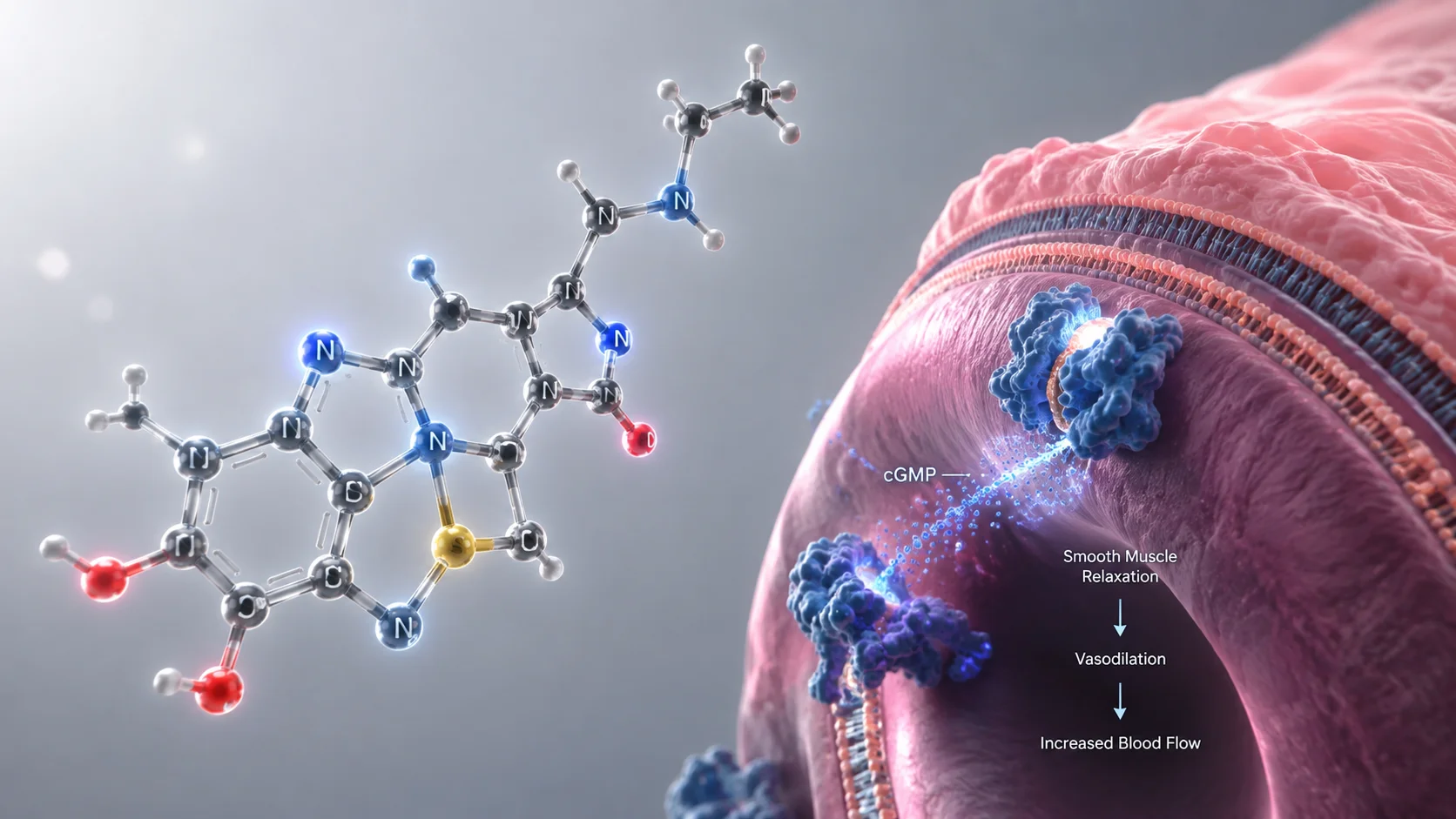
Sildenafil Citrate is an approved PDE5 inhibitor for erectile dysfunction and pulmonary arterial hypertension. It operates primarily by inhibiting the catalytic degradation of cyclic guanosine monophosphate (cGMP), offering arterial vasodilation and vascular smooth muscle relaxation within target tissues.
Essential Chemical and Pharmacological Profile
| Parameter | Clinical Specification |
|---|---|
| Active Substance / Salt | Sildenafil Citrate |
| IUPAC / Chemical Class | Pyrazolopyrimidinone |
| Pharmacological Category | Phosphodiesterase Type 5 (PDE5) Inhibitor |
| ATC Code | G04BE03 |
| Bioavailability | ~40% (absolute oral bioavailability) |
| Plasma Protein Binding | ~96% bound to plasma proteins |
| Elimination Half-Life ($t_{1/2}$) | ~3 to 5 hours |
| Primary Clearance Route | Hepatic (CYP3A4 major, CYP2C9 minor) |
| UK Regulatory Status | POM (Prescription-Only Medicine) / P (Pharmacy Medicine for 50mg Sildenafil) |
How It Works: Mechanism of Action
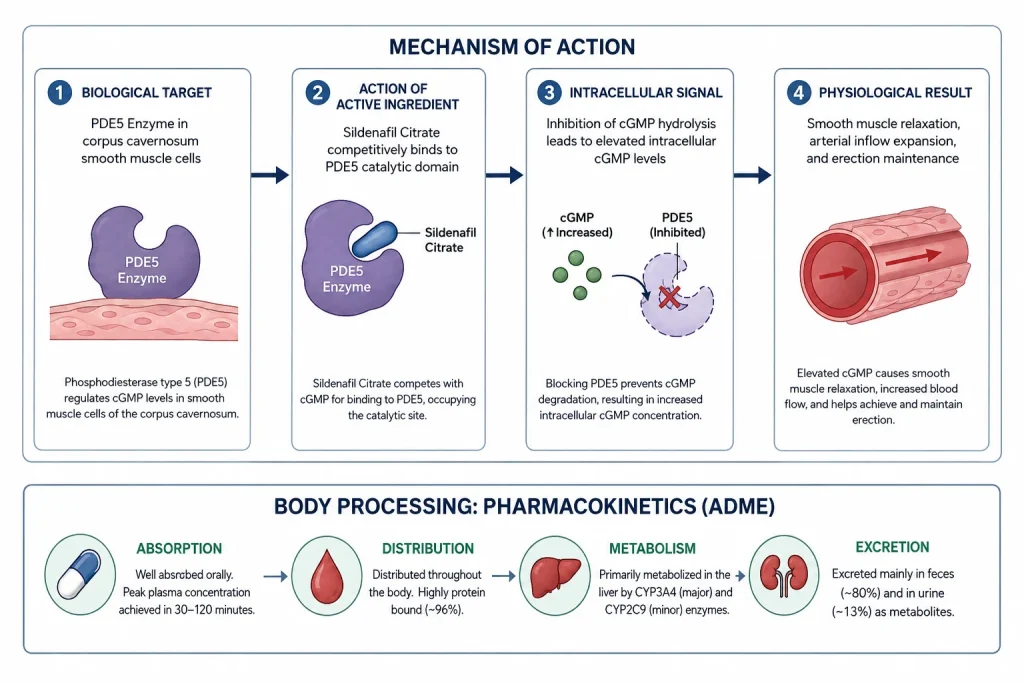
Because Sildenafil Citrate selectively inhibits PDE5, cGMP levels are affected, causing vascular smooth muscle to relax.
Nitric oxide is released from nerve terminals and endothelial cells within the corpus cavernosum, a process triggered by sexual stimulation during arousal.
NO stimulates the enzyme guanylate cyclase, leading to increased cellular levels of cGMP.
A rise in cGMP levels leads directly to the relaxation of smooth muscle, widening of the arteries, and a greater flow of blood into the erectile tissue.
Within the human corpus cavernosum, cGMP is broken down predominantly by the PDE5 isoenzyme.
By competitively binding to PDE5, sildenafil blocks the degradation of cGMP.
Elevated cellular cGMP concentrations are preserved as a result, meaning the natural erectile response to sexual stimulation is enhanced. Sildenafil exerts no direct relaxant effect on isolated tissue without nitric oxide activation.
Body Processing: Pharmacokinetics (ADME)
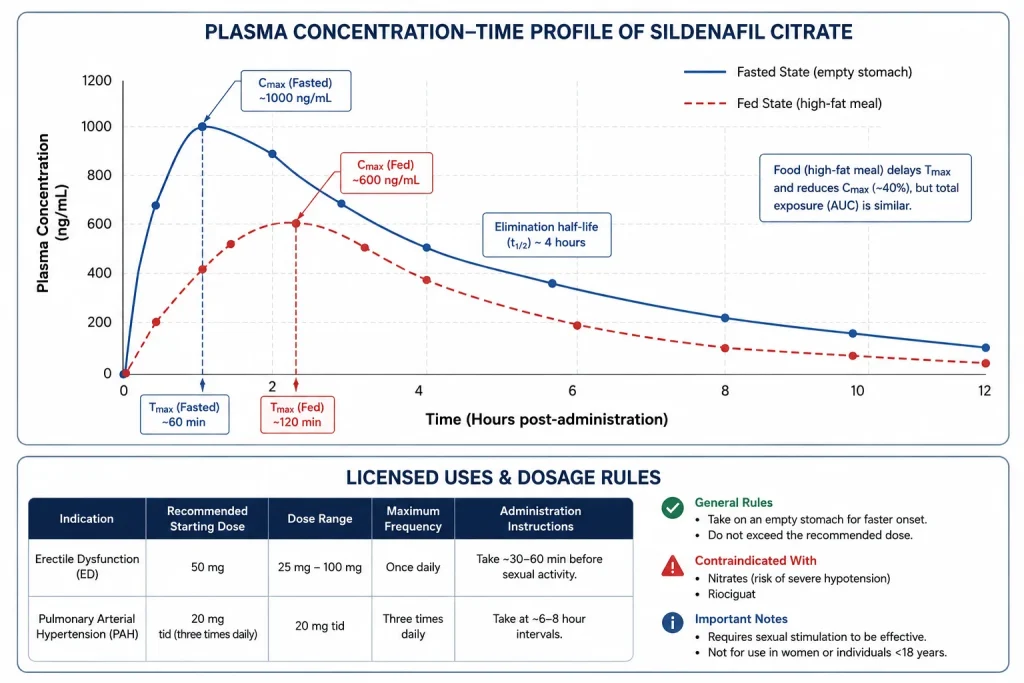
- Absorption: Sildenafil is rapidly absorbed following oral administration. Peak plasma concentration ($C_{max}$) occurs in 30-120 minutes (median $T_{max}$ 60 min) when fasting. A high-fat meal delays absorption, increasing $T_{max}$ by about 60 min and reducing $C_{max}$ by 11% to 29%.
- Distribution: Extensive tissue distribution is indicated by a mean steady-state volume of distribution (Vd) of 105 L. Regardless of total drug concentrations, approximately 96% of Sildenafil and its major circulating active N-desmethyl metabolite remain bound to plasma proteins.
- Metabolism: Hepatic metabolism is primarily mediated by cytochrome P450 isoenzymes CYP3A4 (main hepatic pathway) and CYP2C9 (minor pathway). The active N-desmethyl metabolite undergoes further clearance, possessing ~50% of the parent drug’s PDE5 selectivity and contributing ~20% to overall pharmacological effect.
- Excretion: Excretion is primarily through faeces (~80%) and secondarily through urine (~13%). Terminal elimination half-life ($t_{1/2}$) for sildenafil and its active metabolite is between 3 and 5 hours.
Uses and Dosage Rules
UK NICE and BNF guidelines authorise Sildenafil Citrate for two main conditions.
- Erectile Dysfunction (ED): Adult men who find it consistently difficult to achieve or maintain an erection adequate for satisfactory sexual activity may be prescribed this treatment.
- Pulmonary Arterial Hypertension (PAH): Treatment of adult patients with WHO Class II and III PAH to improve exercise capacity.
Standard Strengths and Titration Guidance
Manufactured adult oral solid dosage forms authorised in the UK for erectile dysfunction are 25mg, 50mg, and 100mg tablets.
- Standard Dose: Patients are generally advised to take 50mg around one hour ahead of planned sexual activity, on an as-needed basis.
- Titration Range: The dose may be adjusted to 25mg or increased to 100mg based on efficacy and tolerability.
- Renal Adjustments: Where a patient has severe renal impairment (creatinine clearance of 30 mL/min or below), the dose should be lowered to 25mg.
- Hepatic Adjustments: Use a 25mg starting dose in hepatic impairment (e.g., cirrhosis) due to lower drug clearance.
Safety and Compatibility: Contraindications and Drug Interactions
Absolute Contraindications:
- Organic Nitrates: Concurrent use with nitric oxide donors, organic nitrates (e.g., nitroglycerin, isosorbide mononitrate/dinitrate), or alkyl nitrites (“poppers”) is strictly contraindicated. Sildenafil potentiates the hypotensive action of nitrates, risking severe hypotension.
- Riociguat: Co-administration with soluble guanylate cyclase (sGC) stimulators is contraindicated due to severe additive blood pressure reductions.
- Cardiovascular Risk: Unstable angina, severe heart failure, recent myocardial infarction or stroke (6 months), and resting hypotension.
Drug-Drug Interactions:
- Major (CYP3A4 Inhibitors): Strong CYP3A4 inhibitors (e.g., ketoconazole, itraconazole, ritonavir, erythromycin) significantly increase sildenafil plasma concentration ($AUC$ and $C_{max}$). Initiating therapy at 25mg is clinically recommended.
- Alpha-Blockers: Concomitant administration with alpha-blockers (e.g., tamsulosin, doxazosin) requires patient hemodynamic stability prior to initiating treatment to minimise orthostatic hypotension risk.
Side Effects and Reporting
Adverse reactions are classified using standard CIOMS frequency categories:
| Frequency Category | Side Effects |
|---|---|
| Common (≥1/100 to <1/10) | Headache, flushing, dyspepsia, nasal congestion, dizziness, visual colour distortion (chromatopsia) |
| Uncommon (≥1/1,000 to <1/100) | Hypersensitivity reactions, visual brightness/eye pain, palpitations, tachycardia, gastro-oesophageal reflux (GORD), dry mouth |
| Rare/Serious (<1/1,000) | Priapism (prolonged erection lasting >4 hours requiring emergency clinical care), sudden hearing loss, NAION, cerebrovascular event, unstable angina |
Adverse Reaction Reporting:
uspected adverse drug reactions (ADRs) should be reported to the MHRA via the Yellow Card Scheme, either at yellowcard.mhra.gov.uk or through the app.
References and Evidence Sources
- MHRA Summary of Product Characteristics (SmPC): Sildenafil 25mg, Film-Coated Tablets
- NCBI / PubMed Literature: Goldstein I, et al. Oral sildenafil in the treatment of erectile dysfunction.
Medical Disclaimer
Medical Disclaimer: This entry is a pharmacological reference monograph intended solely for educational and informational purposes for healthcare professionals and researchers. Medical advice or prescribing recommendations are not provided here. Instead, clinical decisions must be made by a qualified healthcare professional, in line with UK licensed indications.